Dedicated Nut-Free Facility vs Shared Equipment: Why It Matters for Your Safety
Oct 23, 2026
When it comes to choosing safe snacks for people with nut allergies, the distinction between a dedicated nut-free facility vs shared equipment is one of the most important factors you can consider. Cross-contact from shared cooking and serving tools is a well-known cause of allergic reactions, which means the environment where food is made carries just as much weight as the ingredients list on the label.
Key Takeaways
| Question | Answer |
|---|---|
| What does a dedicated nut-free facility mean? | It means the facility doesn't use tree nuts or peanuts, which greatly lowers cross-contact risk at the source. |
| Is shared equipment dangerous for nut allergy sufferers? | Yes. Even after cleaning, shared equipment can retain trace allergen proteins that trigger reactions. |
| What does "may contain nuts" really mean? | It signals possible shared equipment or facility exposure, and testing studies have found that some of these products do contain detectable allergens. |
| Are nut-free bars also dairy-free? | Not always. Look for bars specifically labeled both nut-free and dairy-free, made in a dedicated nut-free facility. |
| Why do schools prefer dedicated nut-free snacks? | Schools want clear answers. A dedicated nut-free facility removes a lot of ambiguity and fits most nut-free school policies. |
| Where can I find nut-free bars made in a dedicated facility? | You can browse our full range of nut-free snack bars, all made without nuts at every stage of production. |
| How do I verify a brand's allergen claims? | Ask for a detailed allergen database. Transparent brands publish this information openly so you can verify every product's safety profile. |
What Is a Dedicated Nut-Free Facility vs Shared Equipment?
A dedicated nut-free facility is a production site that doesn't process tree nuts or peanuts. Its equipment, surfaces, ingredients, and employee practices are set up with one goal: keeping nuts out of the production process.
Shared equipment, by contrast, is any manufacturing line or kitchen tool used to make both nut-containing and nut-free products, even if cleaning procedures exist between runs.
The difference sounds straightforward, but the real-world implications are significant. When you pick up a bag of snacks labeled "may contain nuts" or "processed on shared equipment," that is not a technicality. It is a genuine warning that allergen proteins may still be present.
For people managing nut allergies, this distinction is the line between a safe meal and a medical emergency.
Why the Dedicated Nut-Free Facility vs Shared Equipment Debate Matters for Allergy Safety
Allergen proteins are not visible. You cannot see, smell, or taste trace amounts of peanut or tree nut protein left on shared equipment. They can persist even after standard cleaning in some manufacturing environments.
This is why the dedicated nut-free facility vs shared equipment question is not about preference. It is about measurable, documented risk.
Consider how even a small amount of residual protein on a production line can transfer to hundreds or thousands of bars before anyone detects the issue. For someone with a severe allergy, that single bar could be life-threatening.
- Cross-contact happens when an allergen is unintentionally transferred from one food or surface to another.
- Cross-contamination is the broader term covering both allergens and pathogens.
- Shared equipment is one of the most common pathways for cross-contact in food manufacturing.
- Dedicated facilities close off much of this pathway by keeping the source allergen out of the building.
For nut-free snacks and bars, the manufacturing environment has to support that claim from the ground up.
The Hidden Risks of Shared Equipment for Nut-Free Snacks and Bars
Many food brands produce their products on shared lines, cleaning between runs and labeling accordingly. The problem is that cleaning between runs is not always perfect, and trace residues can survive even rigorous wash cycles.
Nuts, especially peanuts and tree nuts, contain proteins that are particularly heat-stable and difficult to fully remove from porous surfaces like conveyor belts, plastic hoppers, and textured rollers commonly found in snack and bar production.
For families buying nut-free snacks for children with allergies, "made on shared equipment" adds uncertainty that a dedicated facility can reduce.
This is where the practical difference between a dedicated nut-free facility vs shared equipment becomes impossible to ignore.
Studies of products with "may contain" warnings show that some of them really do contain detectable allergens. The voluntary "may contain" warning is not a guarantee either way, so it pays to read it carefully.
Dedicated nut-free facilities reduce that uncertainty, because nuts aren't processed in the building.
How Dedicated Nut-Free Facilities Protect You Better Than Shared Equipment
The protection offered by a dedicated nut-free facility goes far beyond a label. It is built into every layer of the operation.
Here is a direct comparison of what separates a dedicated facility from a shared equipment environment:
| Factor | Dedicated Nut-Free Facility | Shared Equipment |
|---|---|---|
| Nuts ever on-site? | No | Yes, for other products |
| Cross-contact risk | Much lower at the source | Reduced but not zero |
| Label accuracy | Nut-free claim is verifiable | Disclaimer required ("may contain") |
| School and camp suitability | Fits most nut-free school policies | Often prohibited by policy |
| Ingredient sourcing | Nut-free supply chain required | Mixed supply chain possible |
| Clearer answers for consumers | High | Uncertain |
The table makes it clear: when we talk about the dedicated nut-free facility vs shared equipment comparison, there is a decisive advantage for anyone managing food allergies seriously.
Nut-Free and Dairy-Free Bars: What to Look for in a Safe Snack
Not all nut-free bars are created equal. Beyond just the nut-free claim, many allergy-conscious consumers also need dairy-free options, making the sourcing and production process even more important.
When both nut-free and dairy-free requirements apply, the dedicated facility model becomes essential. A shared equipment line producing dairy-containing products is just as problematic as one producing nut-containing products, because the same cross-contact risks apply.
Here is what to check when evaluating nut-free, dairy-free snacks and bars:
- Facility type: Is it a fully dedicated nut-free facility, or does it share equipment with other products?
- Allergen labeling: Does the label say "nut-free" clearly, or use cautionary language like "may contain"?
- Ingredient list: Scan for hidden dairy derivatives (casein, whey, lactose) alongside nut ingredients.
- Third-party verification: Does the brand publish an allergen database or have independent testing backing their claims?
- Transparency: Can you contact the brand and get straight answers about their manufacturing environment?
At No Nuts!, every bar we make is produced in a dedicated nut-free environment. Our allergen database is publicly available so you can verify exactly what is and is not in your snacks before you buy.
The Best Nut-Free Snack Bars Made in a Dedicated Facility
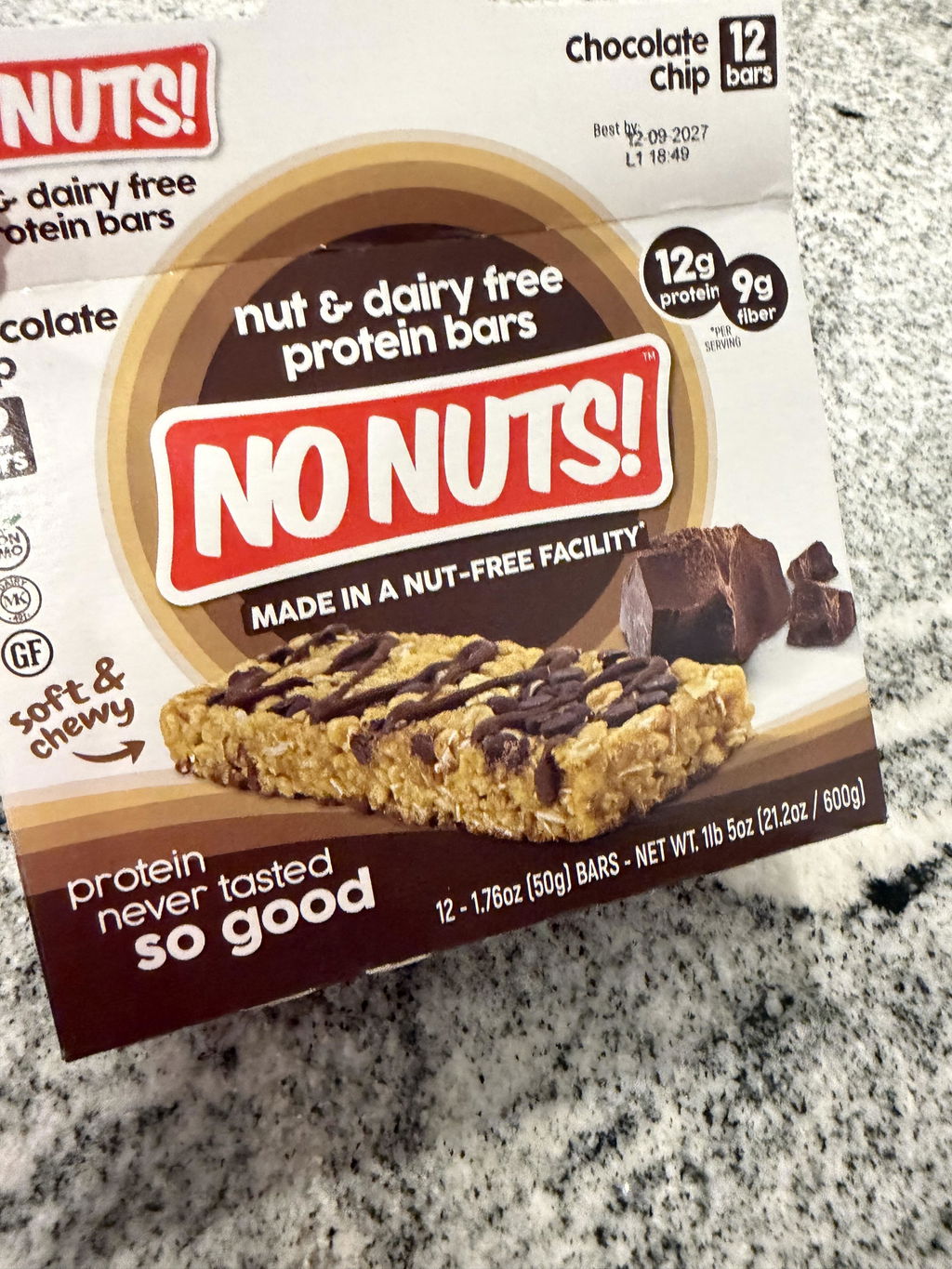
If you are looking for nut-free snacks and bars, the No Nuts! protein bar range is made in a dedicated nut-free facility, and every flavor is made without nuts, dairy, or gluten.
Here is a look at the bars available right now:
- Chocolate Chip 12-Pack: Classic flavor with 12g of protein per bar. A reliable everyday snack for nut-free households and schools.
- Cinnamon Roll 12-Pack: Spiced cinnamon with a vanilla finish. Nut-free and genuinely delicious.
- Blueberry and Vanilla 12-Pack: Bright fruity flavor in a fully nut-free bar. Great for lunchboxes.
- Caramel Mocha 12-Pack: Coffee-infused with caramel undertones. Popular with adults who need a safe, allergen-conscious snack.
Not sure where to start? The Variety Pack gives you three bars of each flavor in one order, so you can try all four before committing to a full box of one.
For schools, camps, and organizations buying in volume, the Wholesale Chocolate Chip 72-Bar Case is the most cost-effective option. You can also apply for a wholesale account to get ongoing pricing for larger orders.
That recall data reinforces a hard truth: regulatory frameworks are catching up, but the structural risk of shared equipment remains. A dedicated nut-free facility does not wait for regulations to force compliance. It builds safety into the foundation of how the product is made.
Dedicated Nut-Free Facility vs Shared Equipment: Questions to Ask Before You Buy
In 2026, more brands than ever are labeling their snacks and bars as "nut-free." Not all of those labels carry the same weight. Before you buy, here are the specific questions you should ask any brand:
- "Is your facility entirely nut-free, or do you run nut products on the same lines?" A clear "yes, dedicated facility" is the strongest answer.
- "Can I see your allergen testing data?" Reputable brands test batches and can share results.
- "Does your 'nut-free' label cover peanuts as well as tree nuts?" Some brands only exclude one category.
- "Is your product also free from dairy, gluten, or other major allergens?" For multi-allergy households, dairy-free and nut-free often need to go together.
- "Are your ingredients also sourced from nut-free suppliers?" The facility is just one link in the chain. Ingredient sourcing matters too.
If a brand can't answer these questions clearly, keep looking.
Why Schools, Camps, and Parents Look for Dedicated Nut-Free Snacks and Bars
Institutions have become increasingly strict about what snacks and bars are allowed on their premises. Most school allergy policies in 2026 explicitly require products made in dedicated nut-free facilities, not just products with nut-free ingredient lists.
The reason is straightforward: schools are responsible for dozens or hundreds of children with different allergy profiles. A "may contain" label is not a usable answer when a child's safety is involved.
Parents shopping for school-safe snacks face this reality every day. They need bars they can pack in a lunchbox with less worry, snacks they can send to birthday parties, and treats for field trips where emergency epinephrine might not be immediately accessible.
The dedicated nut-free facility model answers all of those needs in a way that shared equipment simply cannot.
For high-volume needs, the No Nuts! Variety Pack is a popular starting point for parents and teachers who want to test flavors before ordering in bulk. And with free shipping on orders over $45, stocking up on nut-free snacks for the whole classroom is straightforward.
Reading Allergen Labels Correctly: What the Language Actually Means
Label literacy is one of the most underrated skills for anyone managing food allergies. The language on snack and bar packaging is not standardized in the same way nutritional facts are, which means different brands use different phrases to communicate the same (or very different) levels of risk.
Here is a breakdown of common label terms and what they actually mean in the context of the dedicated nut-free facility vs shared equipment debate:
- "Nut-Free": No nuts used as ingredients. But this does not guarantee the facility or equipment is nut-free unless stated explicitly.
- "Made in a nut-free facility": Nuts are not manufactured at that location. Stronger claim than ingredient-level nut-free.
- "Processed in a facility that also processes tree nuts/peanuts": Shared facility. Allergen transfer is possible.
- "May contain nuts": Voluntary warning for shared equipment or facility risk. Not a guarantee of safety either way.
- "Free from peanuts and tree nuts": Covers both categories. Better than a label covering only one.
The strongest label combination you can find on snacks and bars is "nut-free" combined with explicit "dedicated facility" language, along with a full allergen statement you can read for yourself.
Conclusion
The question of dedicated nut-free facility vs shared equipment is not a minor technical detail. It is the single most important factor separating genuinely safe nut-free snacks and bars from products that carry a label without the substance to back it up.
Shared equipment introduces real, measurable risk. Trace allergen proteins can survive cleaning, transfer to otherwise nut-free products, and cause reactions. Cross-contact from shared equipment is a known cause of accidental allergen exposure, and "may contain" labels can reflect a real presence of allergens in tested products.
A dedicated nut-free facility removes the source of that risk. No nuts in the building means no nuts on the equipment, in the air, or on your bars. Combined with dairy-free formulations and full allergen transparency, it is the standard that every nut-free snack brand should be meeting.
We built No Nuts! on exactly that standard. Every bar we make, from Chocolate Chip to Caramel Mocha, starts and finishes in a facility where nuts are never present. You can explore the full range at our shop all nut-free snack bars collection, or start small with a sample to taste the difference that real safety assurance makes.
Frequently Asked Questions
What is the difference between a dedicated nut-free facility and shared equipment?
A dedicated nut-free facility doesn't process nuts on-site, which greatly lowers cross-contact risk. Shared equipment is used for both nut-containing and nut-free products, so trace allergen proteins can transfer even after cleaning.
Is "made on shared equipment" safe for someone with a peanut allergy?
It depends on the person and the severity of the allergy, so ask your allergist. Testing studies have found detectable peanut protein in some products labeled "may contain," so the risk is real, not just theoretical.
Why do schools require nut-free snacks made in dedicated facilities?
Schools cannot manage the uncertainty of "may contain" warnings when children with severe allergies are present. A dedicated nut-free facility provides a verifiable, policy-compliant level of safety that shared equipment snacks and bars simply cannot match.
Are there nut-free bars that are also dairy-free and gluten-free?
Yes. No Nuts! bars are nut-free, dairy-free, and gluten-free, all made in a dedicated facility. They are designed specifically for multi-allergy households and school-safe snacking. You can find the full range in our nut-free snack bars collection.
How do I verify that a nut-free snack brand actually uses a dedicated facility?
Ask the brand directly, look for explicit "dedicated facility" language on their website, and check whether they publish an allergen database with testing documentation. Transparent brands make this information easy to find. Brands that only say "nut-free ingredients" without addressing their facility should be approached with caution.
Is a dedicated nut-free facility vs shared equipment really that important if I have a mild allergy?
Even for milder sensitivities, shared equipment can add variability from batch to batch. A dedicated facility reduces that variability.
What nut-free snack bars are best for kids with nut allergies in 2026?
Look for bars made in dedicated nut-free facilities that also skip dairy and gluten. No Nuts! protein bars in flavors like Chocolate Chip and Blueberry Vanilla are made in a dedicated nut-free facility, are free from peanuts, tree nuts, dairy, eggs, and gluten, and taste great.
A note on allergies: This article is general information, not medical advice. Ingredients and facility practices can change, so always read the full label and allergen statement before eating any food, and talk with your doctor or allergist about your own needs.
No Nuts! protein bars (Chocolate Chip, Blueberry & Vanilla, Caramel Mocha and Cinnamon Roll) are made in a nut-free facility, and every ingredient is listed on our ingredients page. Our Chewy Chocolate Chip Granola Bars are made without the 9 major U.S. allergens (including soy); the facility also processes coconut.