

Are Oreos Nut-Free? The Complete Allergen Guide for 2026
Apr 08, 2026
If you or your child has a nut allergy, you have probably wondered: are Oreos nut-free? With 83% of Gen Z consumers regularly eating Oreo cookies, this iconic snack appears at nearly every birthday party, classroom celebration, and after-school gathering, making the allergen answer one of the most important things an allergy-aware family can know.
Key Takeaways
| Question | Answer |
|---|---|
| Are Oreos nut-free? | Classic Oreos do not contain peanuts or tree nuts as ingredients, but they are manufactured in facilities that handle nuts, creating a cross-contact risk. |
| Are Oreos dairy-free? | Standard Oreos list no milk ingredients, but Nabisco notes they are made on shared equipment with milk products, so they are not considered dairy-free by strict standards. |
| Do Oreos carry a "may contain nuts" warning? | Many Oreo varieties carry precautionary allergen labeling (PAL) noting the presence of tree nuts or peanuts in the facility. |
| Are all Oreo flavors equally safe? | No. Some limited-edition and specialty Oreo flavors contain nuts directly as ingredients, such as certain peanut butter varieties. |
| Are Oreos safe for school nut-free policies? | Generally not recommended for strictly nut-free school environments due to facility cross-contact risks. |
| What are the best nut-free Oreo alternatives? | Certified nut-free snack bars and cookies from dedicated nut-free facilities offer the safest option for allergy-sensitive households and schools. |
| Where can I find certified nut-free snacks? | Dedicated nut-free brands like No Nuts! nut-free snack collection manufacture in 100% nut-free certified facilities. |
Are Oreos Nut-Free? What the Label Actually Says
The short answer is complicated, and for allergy families, complicated is never reassuring.
Classic Original Oreos do not list peanuts or tree nuts as direct ingredients. The core recipe contains unbleached enriched flour, sugar, palm and canola oil, cocoa, high fructose corn syrup, leavening agents, soy lecithin, and artificial flavor.
However, Nabisco (owned by Mondelez International) openly states on packaging that Oreos are manufactured in facilities that also process peanuts and tree nuts. This is the critical distinction that every allergy-aware parent, teacher, and caregiver needs to understand.
The ingredient list is not the whole story. Cross-contact during manufacturing is a real and documented risk, and precautionary allergen labeling (PAL) phrases like "may contain" or "made in a facility with" exist specifically to communicate that risk.
For a child or adult with a severe peanut or tree nut allergy, this facility-level exposure is enough to rule Oreos out entirely. That is not an overreaction; it is exactly what the label is asking you to consider.
The Cross-Contact Problem: Why "Nut-Free" Requires More Than No Nuts on the Ingredient List
Cross-contact happens when an allergen from one product transfers to another during manufacturing, often through shared equipment, shared production lines, or shared air space.
It is not the same as cross-contamination, though the two terms are often used interchangeably. Cross-contact does not require a "mistake" to occur. It is a structural reality of manufacturing in a facility that handles multiple products.
Oreo cookies are produced at scale in large facilities that also produce other Mondelez snacks, some of which contain nuts. Even if the Oreo line is cleaned between runs, the risk of residual allergen exposure remains real enough that the company prints the warning on the label.
For families managing severe nut allergies, this means that asking "are Oreos nut-free?" based solely on the ingredient list gives you an incomplete and potentially dangerous answer.
Which Oreo Varieties Are Most Likely to Contain Nut Warnings?
Not all Oreos carry the same level of allergen risk. Understanding the differences between varieties helps you make a more informed decision, though our position is always to default to certified nut-free alternatives when safety is the priority.
- Original Oreos: No nuts as direct ingredients, but facility-level cross-contact warning present.
- Oreo Peanut Butter: Contains peanut butter as a direct ingredient. Not nut-free by any definition.
- Oreo Fudge Cremes and Specialty Varieties: Many contain additional chocolate coatings or fillings processed on nut-adjacent lines. Check the label on each specific variety.
- Limited Edition Oreos: These change frequently and some have included nut-containing ingredients such as hazelnut or almond. Always check the label of limited-edition products, not just the standard version.
- Oreo Thins: Facility warnings apply. Ingredient list varies slightly but the manufacturing environment concern remains consistent.
The safest rule is this: if the label mentions nuts in the facility, treat the product as a potential nut risk regardless of the ingredient list.
Discover three quick checks to determine if Oreos are nut-free. Includes allergen guidance and cross-contact notes for safe snacking.
Are Oreos Dairy-Free? Understanding All the Allergen Layers
This is another question that comes up right alongside the nut conversation, and it deserves a clear answer.
Original Oreos do not contain milk as a direct ingredient, which is why they have long appeared on lists of "accidentally vegan" snacks. However, Nabisco states that Oreos are made on shared equipment with milk products.
This means Oreos are not considered dairy-free by the standards used in the allergy community, even though no milk is listed in the ingredients. For someone with a true dairy allergy (not just a dietary preference), this matters significantly.
For families dealing with both nut and dairy restrictions, the answer to both "are Oreos nut-free?" and "are Oreos dairy-free?" comes back with the same caveat: the facility risk makes them unsuitable for strict allergy management.
This is exactly why many allergy-aware families look for snacks and bars that are certified free from all major allergens from a dedicated facility, not just those that happen to have a clean ingredient list.
Are Oreos Safe for School? What Nut-Free Policies Actually Require
School nut-free policies vary by district and even by classroom, but most follow a consistent standard: if a product carries any precautionary allergen labeling related to nuts, it does not qualify as nut-free under school guidelines.
Under this standard, Original Oreos do not pass the threshold for most nut-free classrooms. The facility warning is enough to disqualify them.
This creates a real social challenge. Oreos are one of the most recognizable and popular snacks in the country, and children who cannot bring them to school or eat them at parties can feel excluded from shared snack moments.
We believe snacks should bring people together, not leave anyone out. That is why finding genuinely certified alternatives matters so much, especially for school events, birthday parties, and summer camps where shared snacking is central to the experience.
For parents looking for school-safe options, our summer camp nut-free snack guide walks through what certified nut-free actually means in practice and how to find products that meet school and camp standards.
Best Nut-Free Snack Bars as Oreo Alternatives in 2026
If Oreos are off the table for your household or classroom, the good news is that genuinely certified nut-free snacks exist, and the best of them do not ask you to sacrifice taste to stay safe.
At No Nuts!, we have built our entire product line around a 100% nut-free supply chain, from sourcing raw ingredients all the way through production in our Health Canada certified facility in Quebec, Canada. Zero peanuts. Zero tree nuts. Zero risk. That is not a reformulation or a workaround. It has been our standard since day one.
Here are our top nut-free bar options that work as everyday snacks and school-safe alternatives:
No Nuts! Chocolate Chip Snack Bars

Our Chocolate Chip Snack Bars deliver the familiar chocolate flavor that makes Oreos so appealing, without any nut or dairy risk. Each bar is peanut-free, tree-nut-free, dairy-free, gluten-free, egg-free, sesame-free, vegan, and non-GMO.
At $32.99 for a 12-bar pack (or $29.69 with a subscription), these bars deliver 12g of protein and 9-10g of fiber per serving, making them a functional snack rather than just a "safe" cookie substitute. They are trusted by schools and camps nationwide because they meet certified nut-free facility standards, not just a clean ingredient list.
No Nuts! Blueberry and Vanilla Snack Bars

The Blueberry and Vanilla Snack Bars are a favorite among kids who want something a little lighter than chocolate. Dairy-free, fully allergen-certified, and kid-approved, these bars are priced at $32.99 per 12-bar pack.
They hold up well in lunchboxes and are safe to bring to any nut-free classroom without a second thought.
No Nuts! Caramel Mocha Snack Bars

For older kids and adults, the Caramel Mocha Snack Bars hit a more sophisticated flavor note. Gluten-free and fully nut-free, at $32.99 for a 12-bar pack, these are a strong choice for anyone looking for a grown-up allergen-safe snack option.
No Nuts! Variety Pack
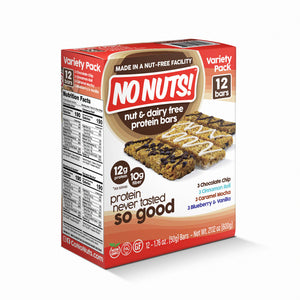
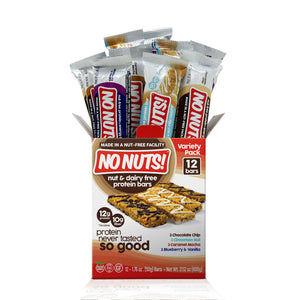
Not sure which flavor is the right fit? Our school-safe nut-free variety pack includes all four core flavors: Chocolate Chip, Cinnamon Roll, Blueberry and Vanilla, and Caramel Mocha. It is the easiest way to find a new favorite without committing to a full box of one flavor.
How to Read Allergen Labels on Snacks and Bars Correctly
Reading allergen labels correctly is one of the most protective habits an allergy-aware family can build. Here is a practical breakdown of what to look for:
- Ingredient List: Nuts listed here mean the product directly contains nuts. This is the most obvious disqualifier.
- "Contains" Statement: This is a mandatory FDA disclosure for major allergens. If you see "Contains: Tree Nuts" or "Contains: Peanuts," the product is not nut-free.
- Precautionary Allergen Labeling (PAL): Phrases like "may contain," "made in a facility with," or "processed on shared equipment with" are voluntary disclosures. They are not legally mandated, which means their absence does not guarantee safety. Their presence means real risk.
- Facility Certification: The gold standard for nut-free snacks is production in a certified nut-free facility. This goes beyond the label and into the supply chain itself.
For more detailed ingredient and nutrition information on our bars, visit our No Nuts! ingredients and nutrition facts page.
Are Oreos Nut-Free? What Multi-Allergen Families Need to Know
The data above makes something very clear: for most allergy families in 2026, the question is never just about nuts.
If your child reacts to dairy, soy, gluten, or eggs in addition to nuts, Oreos fall short on multiple fronts simultaneously. The shared-equipment dairy warning, the soy lecithin in the formula, and the facility nut risk create a layered problem that a single clean ingredient list cannot solve.
This is exactly why we built No Nuts! bars to be free from all eight major allergens, not just nuts. Every bar is peanut-free, tree-nut-free, dairy-free, gluten-free, egg-free, and sesame-free. For many families, finding a snack that checks all those boxes at once is genuinely rare.
After years of research, taste testing, and allergen-safety validation, we designed flavors that kids actually want to eat, because a safe snack that sits uneaten in a lunchbox helps nobody.
The Certified Nut-Free Standard: Why Facility Matters More Than the Label
We use the phrase "certified nut-free facility" deliberately, because it means something specific and verifiable.
Our production facility in Quebec, Canada is Health Canada certified as nut-free. That certification extends back through our supply chain to where raw ingredients are sourced. We do not simply check the finished product. We maintain a 100% nut-free supply chain from ingredient origin to the bar in your hand.
This is the standard we believe all school-safe and allergy-safe snacks should meet. It is what separates a "no nuts listed on the label" product from a genuinely safe one.
When schools and camps across the country trust our bars for their students, it is because they have verified that our nut-free promise is structural, not situational.
You can explore our full range of certified nut-free snacks and bars at the No Nuts! snack bar collection or read answers to common allergen questions on our FAQ page.
Conclusion: Are Oreos Nut-Free? The Bottom Line for Allergy Families in 2026
So, are Oreos nut-free? The honest answer is: not by the standards that matter most for allergy safety.
Classic Oreos do not contain nuts as direct ingredients, but the facility cross-contact warning means they do not meet the threshold for certified nut-free environments, including most school nut-free policies. Specialty Oreo varieties, like peanut butter flavors, contain nuts directly. And the shared-equipment dairy warning means they are not dairy-free either.
For families managing nut allergies, and especially for the majority of allergy children who have multiple food triggers, Oreos carry too many unresolved risks to be considered a safe default snack.
The good news is that genuinely nut-free snacks exist in 2026 that deliver real flavor without compromise. Our No Nuts! bars are certified free from peanuts, tree nuts, dairy, gluten, eggs, and sesame, manufactured in a 100% nut-free facility, and trusted by schools and camps nationwide.
No nuts. No worries. Flavor without fear. That is the standard every allergy snack should meet, and it is the standard we hold ourselves to every single day.
Frequently Asked Questions
Are Oreos nut-free and safe to bring to school?
Original Oreos do not list nuts as direct ingredients, but they carry precautionary allergen labeling indicating they are made in a facility that handles nuts. Most school nut-free policies disqualify any product with this type of facility warning, so Oreos are generally not considered safe for nut-free classrooms.
Do Oreos have a "may contain nuts" warning on the label?
Yes, most Oreo varieties include precautionary labeling noting that they are manufactured in a facility that processes peanuts and tree nuts. This warning applies even to the classic Original Oreo, which does not list nuts in its ingredient formula.
Are Oreos nut-free and dairy-free at the same time?
No. Standard Oreos are not considered dairy-free because they are made on shared equipment with milk-containing products, and they are not considered nut-free because of facility cross-contact risks. For families managing both restrictions, Oreos present dual allergen concerns.
Which Oreo flavors actually contain nuts as ingredients?
Oreo Peanut Butter varieties contain peanut butter as a direct ingredient and are clearly not nut-free. Some limited-edition flavors have also included hazelnut and almond-based ingredients. Always check the current label of any Oreo variety before consuming, as formulations and flavors change frequently.
What is the best nut-free alternative to Oreos for kids in 2026?
The best alternatives are snack bars and cookies produced in certified nut-free facilities, where the safety guarantee extends to the entire supply chain, not just the ingredient list. No Nuts! bars are peanut-free, tree-nut-free, dairy-free, gluten-free, and egg-free, making them one of the most comprehensive allergen-safe snack options available for kids and schools in 2026.
Can someone with a severe peanut allergy eat Oreos?
For someone with a severe peanut allergy, the facility cross-contact risk on Oreo packaging is significant enough that most allergists and allergy advocacy organizations would advise against consuming them. The majority of individuals with peanut allergies strictly avoid products with any precautionary peanut or nut labeling.
Are Oreos nut-free if they were recently reformulated in 2026?
As of 2026, Nabisco has not announced a reformulation that changes the facility manufacturing risk for Oreos. The core allergen concern with Oreos is not the ingredient formula itself but the shared-facility environment, which remains in place. Always check the current label on any product, as formulations and facility practices can change without broad announcement.

