Nut-Free vs Peanut-Free: What Parents Need to Know When Choosing Safe Snacks
Apr 24, 2026
If you've spent time staring at snack packaging trying to figure out the difference between nut-free vs peanut-free, you are not alone. According to a 2015-2016 U.S. survey, 2.2% of children had a convincing peanut allergy compared to 1.8% with a convincing tree nut allergy, which means these two labels address two overlapping but genuinely different risks. Knowing which label matters for your child could be the most important thing you read today.
Key Takeaways
- Nut-free vs peanut-free are not interchangeable. "Peanut-free" covers only peanuts. "Nut-free" (or "tree-nut-free") covers almonds, cashews, walnuts, pecans, and other tree nuts. A product can be peanut-free but still contain tree nuts, and vice versa.
- Cross-contact is the real danger. A product made on shared equipment with nuts can trigger a reaction even if nuts aren't an ingredient. Always look for a dedicated nut-free facility claim, not just a label.
- School policies usually require both. Most nut-free school policies ban peanuts AND tree nuts. A "peanut-free" label alone won't cut it for the lunchbox.
- Dairy-free and gluten-free matter too. Many kids with nut allergies also have other dietary restrictions. The best school-safe snacks cover all of it in one bar.
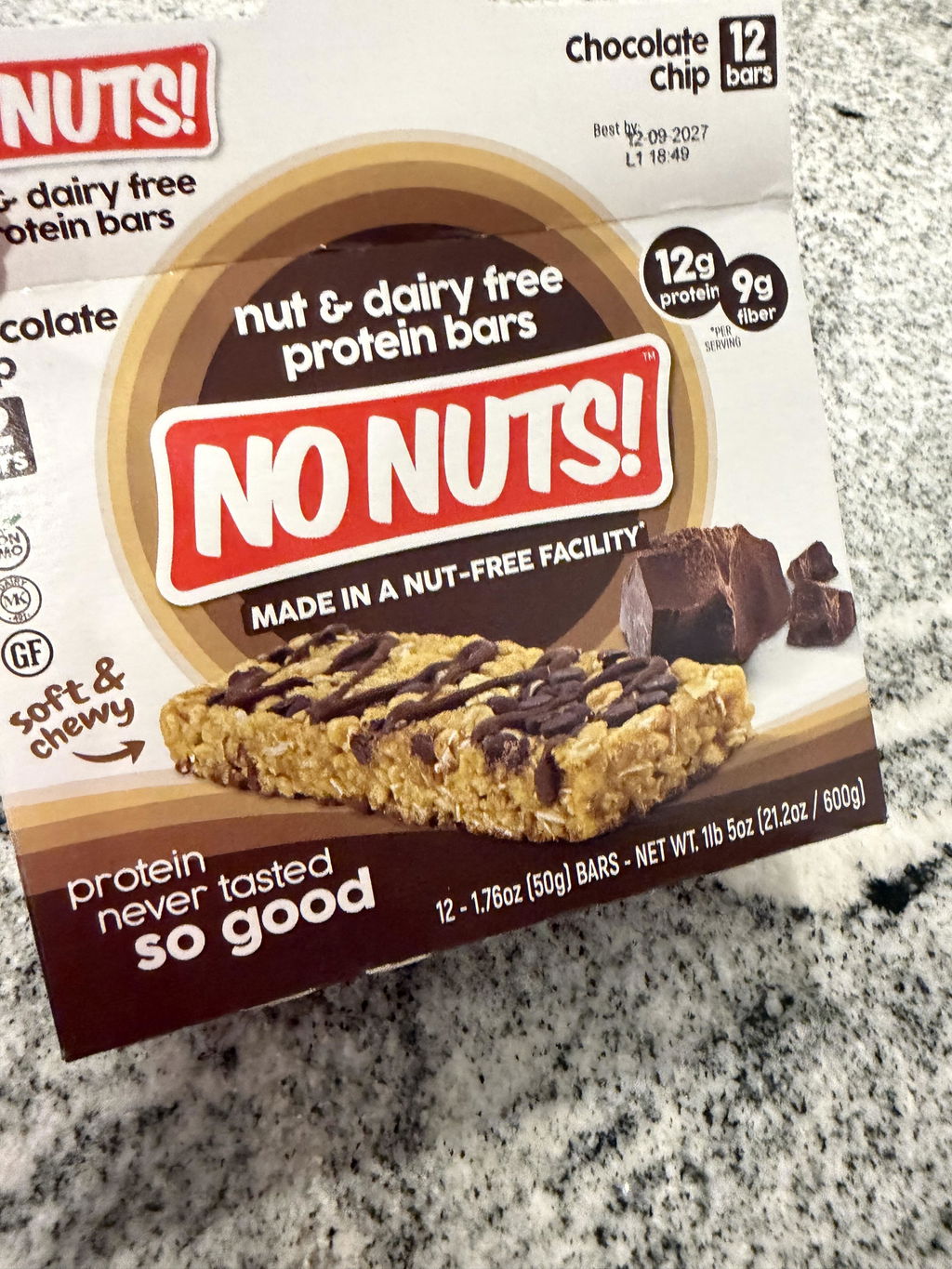
- No Nuts! bars are free from peanuts, tree nuts, dairy, eggs, and gluten, made in a certified 100% nut-free facility, not a shared line. Browse our full nut-free protein bar collection here.
- Reading labels is not enough on its own. Look for facility claims and allergen certifications alongside ingredient lists.
- Nutrition still counts. Worry-free snacks should also be high-protein and satisfying. No Nuts! bars pack 12g of protein and 10g of fiber in every bar, at 180 to 190 calories each.
What Does Nut-Free vs Peanut-Free Actually Mean?
Here's where it gets confusing. Peanuts are not tree nuts. They're legumes, botanically closer to beans and lentils than to almonds or cashews.
So when a label says "peanut-free," it means exactly that. No peanuts. But it says nothing about tree nuts like almonds, cashews, walnuts, hazelnuts, or pecans.
When a label says "nut-free" or "tree-nut-free," it typically covers all tree nuts. But here's the catch: some "nut-free" claims don't explicitly include peanuts, because peanuts aren't botanically nuts.
Bottom line? A product can be:
- Peanut-free but contain tree nuts (like almond butter bars)
- Tree-nut-free but contain peanuts (like some peanut butter cookies)
- Both peanut-free AND tree-nut-free (what most parents actually need)
When we say No Nuts!, we mean all of it. No peanuts. No tree nuts. No problem.
Why Nut-Free vs Peanut-Free Labels Don't Always Tell the Full Story
Even when a product carries one of these labels, it doesn't automatically mean it's safe for someone with a severe allergy.
The label tells you what's in the product. It doesn't always tell you what's been near it.
Manufacturing matters enormously. A bar with no nuts in the ingredient list can still cause a reaction if it's produced on the same equipment as nut-containing products. That's cross-contact, and it's one of the leading causes of accidental allergic reactions.
Phrases like "may contain peanuts" or "manufactured in a facility that also processes tree nuts" are voluntary. They're precautionary warnings, not regulatory requirements. Some products carry them. Many don't, even when shared equipment is used.
That's exactly why the facility matters as much as the label.
At No Nuts!, our bars are made in a dedicated 100% nut-free facility, not a shared line, not a facility that "also handles" nut products. The whole building is nut-free. That's not a claim you see every day, and it's the one that actually protects your child.
How to Read Labels: Nut-Free vs Peanut-Free Snack Bars
When you're shopping for allergy-safe snacks, here's your checklist. Run through this every single time.
- Read the ingredient list. Look for peanuts, peanut oil, peanut flour, and all tree nut names: almonds, cashews, walnuts, pecans, pistachios, macadamia nuts, hazelnuts, Brazil nuts, pine nuts, and chestnuts.
- Read the "contains" statement. U.S. FDA requires that the top 9 allergens (including peanuts and tree nuts) be listed clearly. This is your legal safety net.
- Read the advisory statement. "May contain," "made in a facility," or "on shared equipment" are all warnings worth taking seriously.
- Look for a facility claim. "Made in a dedicated nut-free facility" is the gold standard. "Nut-free" on the front of the pack means nothing if the facility isn't certified.
- Check certifications. Non-GMO, Kosher, and third-party verified claims give you additional confidence in production standards.
No Nuts! bars clear every single one of these checkpoints. Every No Nuts! bar is free from peanuts, tree nuts, dairy, eggs, and gluten, without sacrificing flavor or nutrition. See the full ingredients breakdown here.
Cross-Contact: The Hidden Risk in Nut-Free vs Peanut-Free Snacks
Cross-contact is not the same as cross-contamination (though people use the terms interchangeably). Cross-contact happens when an allergen is unintentionally transferred from one food or surface to another, without any visible sign that it occurred.
A protein bar produced on a shared line with an almond product could carry enough peanut or tree nut protein to trigger a reaction in a highly sensitive child, even if the label shows zero nut ingredients.
This is why the nut-free vs peanut-free distinction only goes so far on a label. The facility is the real answer.
Here's what "dedicated nut-free facility" actually means in practice:
- No nut-containing products are manufactured in the building. Not in a different room. Not on a different shift. Not ever.
- Equipment is never shared with nut-processing lines.
- Employees, surfaces, and air are all part of a controlled environment.
That's what we've built. No Nuts! bars are made in a dedicated 100% nut-free facility. No cross-contact risk from shared equipment. No "may contain" advisory on our packaging. That's the worry-free standard.
Nut-Free vs Peanut-Free for School: What Most Policies Actually Require
If your child's school has a nut-free policy, read it carefully. Most policies say "no peanuts or tree nuts." Not just one or the other. Both.
That means a peanut-free bar with almond butter doesn't pass. A tree-nut-free bar with peanut flour doesn't pass either.
School-safe snacking means covering all the bases. High Protein. Allergy Safe. School Ready.
And that's exactly what we designed No Nuts! bars to be. Whether you're packing school lunches for a child with a nut allergy, fueling up before a workout, or just looking for a clean, satisfying snack you can feel good about, No Nuts! bars are made for you.
Each bar is individually wrapped, easy to toss in a lunchbox, and contains 12g of protein and 10g of fiber to keep kids full through the afternoon. At 180 to 190 calories per bar, they have fewer calories than a bowl of raisin bran. And they're way more exciting.
The Best Nut-Free Dairy-Free Bars for Allergy-Conscious Families in 2026
In 2026, the allergy-friendly snack market is more crowded than ever. But most bars still fall short of the full picture. They're peanut-free but contain cashews. They're nut-free but loaded with dairy. They're dairy-free but made on shared equipment with tree nuts.
Finding snacks that clear every hurdle without tasting like cardboard? That's harder. That's what we set out to solve.
No Nuts! bars are free from peanuts, tree nuts, dairy, eggs, and gluten. All four flavors. Every single bar. No exceptions.
Here's what's available right now:
No Nuts! Chocolate Chip
Classic, crave-worthy, and packed with 12g of plant-based protein. The Chocolate Chip bar is the one that converts skeptics. Rich without being heavy. Sweet without being sugary. Order the Chocolate Chip bar here at $32.99 per 12-pack (or $29.69 with Subscribe and Save).
No Nuts! Cinnamon Roll
Warm, cozy cinnamon flavor in a school-safe, nut-free bar. 12g of protein. Zero tree nuts. Zero peanuts. Zero dairy. Shop the Cinnamon Roll bar here.
No Nuts! Blueberry Vanilla
Bright, fruity, and satisfying. The Blueberry Vanilla bar is dairy-free, gluten-free, vegan, and made in our dedicated nut-free facility. Try the Blueberry Vanilla bar here.
No Nuts! Caramel Mocha
Bold caramel and coffee flavor. Totally nut-free. Totally dairy-free. Totally worth it.
No Nuts! Variety Pack
Not sure which flavor to start with? The No Nuts! Variety Pack gives you all four flavors in a 12-bar assortment. 12g of protein, 9g of fiber, and 190 calories per bar. Non-GMO. Kosher certified. School-safe. Trusted by parents, schools, camps, and athletes everywhere.
What Makes a Truly Nut-Free Snack Bar Different From a Peanut-Free One?
We said "No!" to nuts so that everyone, regardless of allergies or dietary restrictions, can say "Yes!" to something special.
That positioning isn't just a slogan. It's a production commitment. Here's what actually separates a genuinely nut-free bar from one that's only peanut-free:
- Ingredient scope: A truly nut-free bar excludes all 14+ tree nut varieties AND peanuts. A peanut-free bar may still contain cashews, almonds, or walnuts.
- Facility control: A dedicated nut-free facility means no tree nuts or peanuts anywhere in the building, not just in the specific product's recipe.
- Advisory language: A genuinely nut-free bar should not carry a "may contain" advisory for peanuts or tree nuts. If it does, the facility claim is not airtight.
- Allergen breadth: The best allergy-safe bars go beyond nuts. Our bars are also dairy-free, egg-free, and gluten-free, because many kids managing nut allergies have additional dietary needs.
- Certifications: Non-GMO and Kosher certifications signal third-party oversight of production standards, which adds another layer of accountability.
Made in a dedicated 100% nut-free facility, our gluten-free, dairy-free, non-GMO bars pack 12g of protein and 10g of fiber to keep you satisfied at school, practice, work, and everywhere in between.
That's the bar we raised. No nuts necessary. Read more about our story and commitment to nut-free snacking here.
Nut-Free vs Peanut-Free: Quick Comparison Guide
| Label Claim | Excludes Peanuts? | Excludes Tree Nuts? | School Safe? |
|---|---|---|---|
| Peanut-Free | Yes | Not necessarily | Depends on school policy |
| Tree-Nut-Free | Not necessarily | Yes | Depends on school policy |
| Nut-Free (vague claim) | Usually | Usually | Check facility claim |
| No Nuts! Bars | Yes | Yes | Yes. Dedicated facility. |
Common Questions Parents Ask About Nut-Free vs Peanut-Free Snacks
"My child is allergic to peanuts only. Does nut-free matter?" Yes, it still matters for school and group settings. Even if your child can tolerate tree nuts personally, their school may ban them all.
"My child is allergic to tree nuts only. Are peanut-free snacks safe?" Not automatically. Tree-nut-only allergies still require you to verify there's no cross-contact risk from peanuts in the facility.
"What if a product says 'made in a nut-free facility' but still has a 'may contain' warning?" That's a contradiction. A true dedicated nut-free facility would not carry a precautionary peanut or tree nut advisory. Be skeptical of packaging that says both.
Have more questions? Visit our full FAQ page for answers on allergens, ingredients, labeling, and our facility.
Conclusion
The nut-free vs peanut-free question has a real answer, and it matters more than most snack labels let on. Peanut-free and nut-free are different claims covering different allergens. For most schools, both matter. For most parents, the facility matters even more than the label.
We built No Nuts! because everyone deserves to love what they eat. We said "No!" to nuts so that everyone, regardless of allergies or dietary restrictions, can say "Yes!" to something special. High Protein. Allergy Safe. School Ready. Our bars are free from peanuts, tree nuts, dairy, eggs, and gluten, made in a 100% dedicated nut-free facility, and built to keep you full with 12g of protein and 10g of fiber per bar.
No nuts, no problem. Choose your nut-free protein bars today.
Frequently Asked Questions
What is the difference between nut-free vs peanut-free on a snack label?
Peanut-free means the product contains no peanuts, but it may still contain tree nuts like almonds, cashews, or walnuts. Nut-free (when it covers both peanuts and tree nuts) is the broader claim. The safest snacks for allergy households are explicitly free from both peanuts and all tree nuts, and produced in a dedicated nut-free facility.
Can a product be nut-free but still cause a peanut allergy reaction?
Yes, if "nut-free" doesn't explicitly include peanuts on the label, or if the product is made on shared equipment with peanut-containing foods. Always look for both an explicit "peanut-free" and "tree-nut-free" claim, plus a dedicated facility statement to minimize cross-contact risk.
Are No Nuts! bars safe for kids with both peanut and tree nut allergies?
Yes. Every No Nuts! bar is free from peanuts, tree nuts, dairy, eggs, and gluten, and made in a 100% dedicated nut-free facility with no shared equipment. They're designed to be school-safe and worry-free for children with nut allergies of all kinds.
What does "made in a dedicated nut-free facility" actually mean in 2026?
It means the entire production facility processes zero nut-containing products, not just the specific line your bar is made on. This is the gold standard for eliminating cross-contact risk. A "may contain" advisory on any product claiming a nut-free facility is a red flag worth questioning.
Is peanut-free the same as tree-nut-free for school lunch policies?
Not usually. Most nut-free school policies in 2026 prohibit both peanuts and tree nuts. A peanut-free snack that contains almond butter or cashew pieces typically won't meet a school's nut-free requirements. Look for bars that are explicitly free from both categories.
What are the best nut-free dairy-free bars for school lunches?
The best nut-free dairy-free bars for school are ones that cover all major allergens, offer real nutrition, and come from a certified dedicated facility. No Nuts! bars check every box: free from peanuts, tree nuts, dairy, eggs, and gluten, with 12g of protein and 10g of fiber per bar, made in a 100% nut-free facility.
Do I still need to read the label if a bar says "nut-free" on the front?
Absolutely. "Nut-free" on the front of a package is a marketing claim, not a regulatory standard. Always read the full ingredient list, the "contains" statement, and any advisory language. Then look for a facility claim that confirms no nut products are produced in the same building.