Nut-Free vs Dairy-Free vs Gluten-Free: What Actually Matters for School-Safe Snack Bars
Sep 09, 2026
When you're searching for the right snack bars, the difference between nut-free vs dairy-free gluten-free isn't just a label question — it's a safety question. Food allergy affects roughly 8% of children and nearly 11% of adults in the U.S., which means millions of families are navigating these exact distinctions every single day, often at the school lunch table.
Key Takeaways
- Nut-free, dairy-free, and gluten-free are three separate allergen categories — a bar can be one, two, or all three. Never assume one label covers the others.
- Nut-free is the top school-safety priority in most districts, because airborne and contact reactions to peanuts and tree nuts can be life-threatening.
- Dairy-free matters most for kids with milk protein allergies or lactose intolerance — it is a distinct need from gluten-free or nut-free.
- Gluten-free alone does not make a bar school-safe — many gluten-free products still contain peanuts, tree nuts, or dairy.
- The manufacturing facility matters as much as the ingredient label — cross-contact risk is real, and a dedicated nut-free facility is the gold standard.
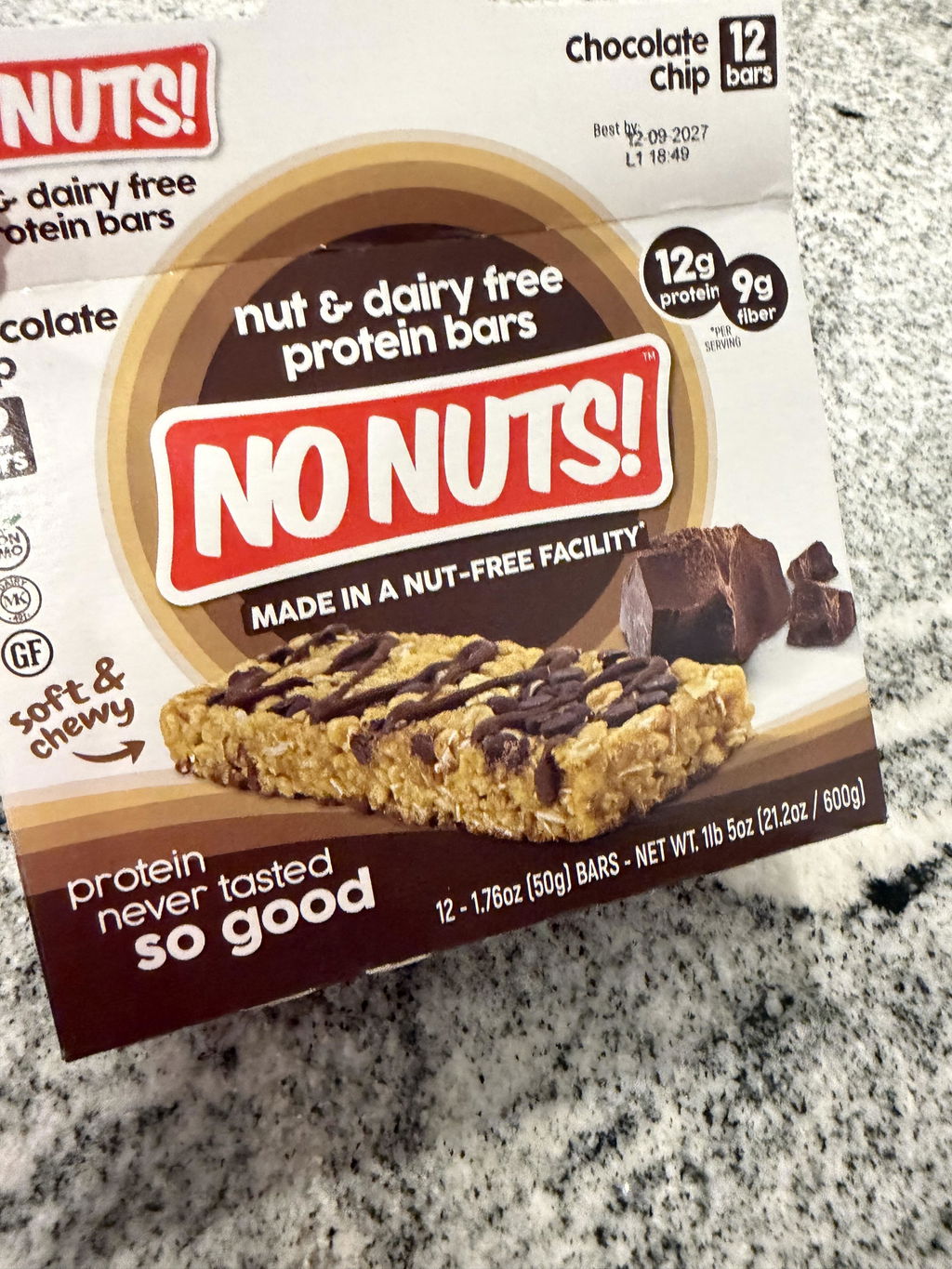
- No Nuts! bars are free from peanuts, tree nuts, dairy, eggs, and gluten — all five, in one bar, made in a dedicated dedicated nut-free facility.
- 12g of protein and up to 10g of fiber per bar: high protein, nut-free, and school ready.

Why Nut-Free, Dairy-Free, and Gluten-Free Are Not the Same Thing
Here's something parents learn fast: these three labels do not overlap automatically. A bar can be gluten-free and still be packed with peanuts. A bar can be dairy-free and still be made on shared equipment with tree nuts.
Each label addresses a completely different allergen category, and each one matters for a different reason. When you're comparing nut-free vs dairy-free gluten-free options, you're really asking three separate questions about three separate risks.
Nut-free means no peanuts, no tree nuts, and ideally no shared production lines with those allergens. Dairy-free means no milk, no whey, no casein. Gluten-free means no wheat, barley, or rye. These are distinct, and the FDA treats them as such.
The FDA lists eight major food allergens for federal labeling: milk, eggs, fish, crustacean shellfish, tree nuts, peanuts, wheat, and soybeans (with sesame later added as the 9th under the FASTER Act). That's the whole picture. Gluten-free labeling covers wheat but says nothing about nuts or dairy.
Bottom line? Every allergen needs its own answer on the label. One "free-from" claim does not do the work of three.
What "Nut-Free" Really Means — and Why Schools Treat It Differently
No Nuts, No Problem. That phrase exists for a reason.
Peanut and tree nut allergies are among the most severe food allergies in existence, with the highest risk of anaphylaxis. That's why schools, camps, and sports programs prioritize nut-free snacks above almost every other dietary need.
"Nut-free" covers two distinct categories that are often confused. Peanuts are technically legumes, not tree nuts. Tree nuts include almonds, cashews, walnuts, pecans, pistachios, and more. A product that's "peanut-free" is not automatically tree-nut-free. For true nut-free protection, both must be absent — from the ingredients and from the facility.
That last part is critical. A bar can have a perfectly clean ingredient label and still pose a risk if it's made on shared equipment with nut-containing products. Cross-contact is real, and it's why the manufacturing facility matters as much as the ingredient list.
We said, "No!" to nuts so that everyone, regardless of allergies or dietary restrictions, can say, "Yes!" to something special. Every No Nuts! bar is made in a dedicated nut-free facility — not a shared line, not an "allergen-controlled" area of a larger plant. Fully dedicated. Fully nut-free.


Dairy-Free vs Nut-Free: Understanding the Difference for School Snack Bars
Dairy-free and nut-free snacks are often lumped together in the "allergy-friendly" category, but they address completely different biological risks.
A milk allergy (or lactose intolerance) requires avoidance of milk proteins and sugars — whey, casein, lactose. This is unrelated to nuts in any form. Many protein bars that proudly claim to be nut-free use whey protein as their base, making them completely off-limits for kids with dairy allergies.
On the flip side, plenty of dairy-free bars use nut butters as their primary protein and fat source. Safe for dairy-free families, dangerous for nut-allergy families. Neither bar is truly school-safe if the classroom has kids with both restrictions.
That's exactly the problem we set out to solve. At No Nuts!, we make delicious nut-free snacks for everyone, especially families managing nut allergies. Our bars use plant-based protein and are free from both dairy and nuts, so you don't have to choose one standard over another.
Dairy-free protein bars that are also nut-free can be hard to find. Many brands pick one lane. We built ours to cover both.
Tree nut allergies can be under-addressed in school food programs, so parents can't always count on the cafeteria to cover them. The snack coming from home has to do the job.
Why Gluten-Free Alone Doesn't Make a Bar School-Safe or Dairy-Free
Gluten-free snacks have exploded in popularity since 2026, driven by celiac disease awareness, wheat sensitivities, and general wellness trends. But "gluten-free" is one of the most misunderstood labels in the snack aisle.
Gluten-free means no wheat, barley, or rye. Full stop. It says nothing about nuts. Nothing about dairy. Nothing about eggs. A gluten-free granola bar can be absolutely loaded with almonds, cashews, and whey protein.
For a family managing a nut allergy, picking up a gluten-free bar without reading further could be genuinely dangerous. The gluten-free label creates a false sense of broader safety that just isn't there.
Now flip it around. A nut-free bar that also contains wheat is fine for the nut-allergy family but completely off the table for celiac or wheat-sensitive kids. These needs don't automatically satisfy each other. They each require their own commitment on the label and in the manufacturing process.
When you're working through nut-free vs dairy-free gluten-free options for school lunches, think of each claim as a separate checkbox — not a sliding scale. All three checkboxes need to be ticked before a bar is genuinely school-safe for kids managing multiple restrictions.


When You Need All Three: Nut-Free, Dairy-Free, and Gluten-Free in One Bar
This is where most snack bars fail the school-safety test.
Classrooms often include kids with multiple, different food allergies. One child might react to peanuts. Another has a milk protein allergy. A third has celiac. A single shared snack that works for all of them has to clear every bar simultaneously. Most products on the market simply don't.
Whether you're packing school lunches for a child with a nut allergy, fueling up before a workout, or just looking for a clean, satisfying snack you can feel good about, No Nuts! bars are made for you. Every No Nuts! bar is free from peanuts, tree nuts, dairy, eggs, and gluten — without sacrificing flavor or nutrition.
That "without sacrificing" part matters. The history of allergy-friendly snacks is littered with products that checked every safety box but tasted like cardboard. We said no to that too.
Our bars pack 12g of protein and up to 10g of fiber per bar, at around 180-190 calories, and they're "slab formed" for a chewy, crunchy texture. These are bars people actually want to eat, not just tolerate.


The Facility Question: Why "Made in a Dedicated Nut-Free Facility" Changes the Nut-Free vs Dairy-Free Gluten-Free Conversation
Labels tell you what's in the bar. The facility tells you what's near the bar.
Cross-contact happens when a product that doesn't contain an allergen as an ingredient still picks up trace amounts during manufacturing — from shared equipment, shared air, shared surfaces. For kids with severe nut allergies, "may contain traces" is not a small-print concern. It's a genuine medical risk.
Many snack bars that claim to be nut-free are made in facilities that also process peanuts or tree nuts. The manufacturer controls for it — cleaning protocols, allergen management plans — but shared facilities carry inherent risk that dedicated facilities simply don't have.
Made in a dedicated nut-free facility, our gluten-free, dairy-free, non-GMO bars pack 12g of protein and up to 10g of fiber to keep you satisfied at school, practice, work, and everywhere in between.
When you're comparing nut-free vs dairy-free gluten-free bars for school, this is the detail that separates safe from safer. A bar that's nut-free only by ingredient list is not the same as a bar that's nut-free by facility. Schools, camps, and allergy families know the difference.


No Nuts! Bars: Nut-Free, Dairy-Free, and Gluten-Free. All Four Flavors.
High Protein. Nut-Free. School Ready.
We have four flavors, and every one is nut-free, dairy-free, and gluten-free. Here's the full lineup:
- Chocolate Chip — The crowd favorite. Soft, chewy, and loaded with chocolate chips. 12g protein, 9g fiber, 190 calories.
- Blueberry Vanilla — Bright and satisfying, with real blueberry flavor. 12g protein, 10g fiber, 190 calories.
- Caramel Mocha — For the kid who wants something a little more grown-up. Rich caramel and coffee notes, still fully nut-free, dairy-free, and gluten-free.
- Cinnamon Roll — Warm and familiar, with 12g protein and 10g fiber. This one disappears fast.
Not sure where to start? The 12-Pack Variety Box gives you all four flavors in one box. Try them all. Everyone deserves to love what they eat.
All flavors are non-GMO, kosher, and plant-based. And all of them are made in a dedicated nut-free facility.


Reading the Nutrition Label: What to Look for When Comparing Allergen-Free Bars
When you're standing in the snack aisle comparing nut-free vs dairy-free gluten-free bars, the nutrition panel and the allergen statement together tell you the full story. Here's what to check:
- Allergen statement ("Contains" line): Look for explicit "Contains: peanuts, tree nuts, milk, wheat" declarations. The absence of these is your first filter.
- "May contain" warnings: These signal shared-facility or shared-equipment risk. For severe nut allergies, these warnings should not be ignored.
- Protein source: Whey = dairy. Many "healthy" bars use whey. If you need dairy-free, scan the ingredient list carefully for whey, casein, or milk protein isolate.
- Gluten-free certification: A certified gluten-free claim (usually under 20 ppm) is more reliable than an uncertified one. It means testing happened, not just intention.
- Facility disclosure: For nut allergies, look for a bar made in a dedicated nut-free facility. If the packaging doesn't say it clearly, contact the brand before you buy.
Our labels make this easy. Full ingredient lists and nutrition facts for every No Nuts! flavor are available so you can check every detail before you buy. Transparency and safety are our priorities. Always.


Who These Bars Are Actually For
To the responsible parents, growing kids, teachers, coaches, and camp directors — these bars are for you.
For the parent packing a school lunch and needing one snack that works for every kid at the table. For the athlete who needs clean, high-protein fuel without worrying about what's in the bar. For the school nurse who has to sign off on snack day. For the camp that needs nut-free snacks in bulk. For the adult who's just done reading ingredient labels that require a chemistry degree.
We built No Nuts! to solve the nut-free vs dairy-free vs gluten-free problem instead of working around it.
Everyone deserves to love what they eat. That's it. That's the whole mission.
Nut-Free vs Dairy-Free Gluten-Free: A Quick Comparison Guide
Not sure which restriction is most relevant to your situation? Here's a straight breakdown:
| Label Claim | What It Covers | What It Does NOT Cover | School Priority |
|---|---|---|---|
| Nut-Free | Peanuts and tree nuts (when both are excluded) | Dairy, gluten, eggs, soy | Very High |
| Dairy-Free | Milk, whey, casein, lactose | Nuts, gluten, eggs, soy | High |
| Gluten-Free | Wheat, barley, rye | Nuts, dairy, eggs, soy | Moderate to High |
| All Three (No Nuts! Bars) | Peanuts, tree nuts, dairy, gluten, AND eggs | Nothing you're worried about | Maximum |
The table above is really the whole argument in four rows. When the stakes are school-safe snacking, covering all three is the only approach that works for every kid.


Conclusion: Nut-Free vs Dairy-Free Gluten-Free — What Actually Matters Is Covering All Three
Nut-free vs dairy-free vs gluten-free is not a competition. It's a checklist. And for school-safe snack bars in 2026, all three boxes need to be checked.
Single-allergen claims leave kids behind. "Gluten-free" doesn't protect the nut-allergy kid. "Dairy-free" doesn't protect the celiac kid. "Nut-free" doesn't protect the milk-allergy kid. Real school safety means being free from peanuts, tree nuts, dairy, eggs, and gluten — and being made in a facility that takes all of that as seriously as you do.
That's what we built. High Protein. Nut-Free. School Ready. No nuts necessary.
Every No Nuts! protein bar is free from peanuts, tree nuts, dairy, eggs, and gluten, without sacrificing flavor or nutrition. Made in a dedicated nut-free facility. 12g of protein. Up to 10g of fiber. Four flavors.
Browse our full nut-free protein bar collection or grab the 12-Pack Variety Box and try all four. Everyone deserves to love what they eat — and we're raising the bar to make sure they can.
Frequently Asked Questions
Is a nut-free bar the same as a dairy-free or gluten-free bar?
No. Nut-free, dairy-free, and gluten-free each address completely separate allergen categories. A bar can be nut-free but still contain dairy or wheat. If your child needs to avoid all three, look for a bar that's explicitly free from each one. No Nuts! protein bars are free from peanuts, tree nuts, dairy, eggs, and gluten.
Can a gluten-free protein bar still be dangerous for nut allergy kids?
Absolutely. Many gluten-free bars use almond flour, cashew butter, or other nut-based ingredients as their primary base. "Gluten-free" says nothing about nuts. Always check the full allergen statement and the "may contain" warning before sending any bar to school.
What does "nut-free facility" actually mean for school-safe snack bars?
A dedicated nut-free facility doesn't process peanuts or tree nuts, which greatly lowers the cross-contact risk that shared facilities and shared equipment can't fully prevent. No Nuts! bars are made in a dedicated nut-free facility.
Are there snack bars in 2026 that are nut-free, dairy-free, and gluten-free all at once?
Yes, though they can be hard to find. Many bars make only one or two allergen-free claims. No Nuts! protein bars are free from peanuts, tree nuts, dairy, eggs, and gluten, all in one bar from a dedicated nut-free facility. They pack 12g of protein and up to 10g of fiber per bar and are non-GMO and kosher.
Why do schools care more about nut-free than gluten-free or dairy-free?
Peanut and tree nut allergies carry the highest risk of anaphylaxis, which can be triggered by contact or airborne exposure — not just ingestion. This makes nut-free the top priority in most school food policies. Dairy and gluten restrictions are equally important for individual kids, but they typically present different (usually less immediately life-threatening) reactions.
Do nut-free protein bars have enough protein without using nut-based ingredients?
Yes. No Nuts! bars deliver 12g of plant-based protein per bar without any nuts, dairy, or eggs. The protein comes from non-nut plant sources, which is exactly why the bars work for people with multiple food restrictions — you get real nutrition without the allergen risk.
Do No Nuts! bars work for kids with both a nut allergy and celiac disease?
No Nuts! protein bars are free from peanuts, tree nuts, dairy, eggs, and gluten (we use gluten-free oats) and are made in a dedicated nut-free facility. They are also non-GMO and kosher. If your child has celiac disease, check the label and talk with their doctor about what's right for them. Have questions about specific ingredients? Our full FAQ page covers allergen and ingredient details for every flavor.
A note on allergies: This article is general information, not medical advice. Ingredients and facility practices can change, so always read the full label and allergen statement before eating any food, and talk with your doctor or allergist about your own needs.
No Nuts! protein bars (Chocolate Chip, Blueberry & Vanilla, Caramel Mocha and Cinnamon Roll) are made in a nut-free facility, and every ingredient is listed on our ingredients page. Our Chewy Chocolate Chip Granola Bars are made without the 9 major U.S. allergens (including soy); the facility also processes coconut.